What is Forex Trading? The Ultimate Beginner’s Guide
Have you ever traveled abroad and swapped your local number for foreign cash? If so, you have already participated in the global Forex market.
For most people, currency exchange is just a holiday chore. For traders, it is a massive opportunity.
But what is Forex trading, and how does it actually work? Let’s break down the world’s largest financial market in simple terms.
Understanding Forex Market Basics

What is the Foreign Exchange Market?
Forex stands for Foreign Exchange. It is the decentralized global marketplace where individuals, corporations, and central banks trade international currencies against one another.
Global Scale: The World’s Largest Financial Market
Unlike the stock market, Forex has no central physical exchange. It operates electronically 24 hours a day, five days a week. It is completely unparalleled in scale, trading trillions of dollars every single day. This massive scale creates high liquidity, meaning you can buy and sell currencies instantly with a simple click.
How Forex Trading Works?
In Forex, currencies never trade alone. They always trade in pairs, like EUR/USD or GBP/USD. You are always buying one currency while simultaneously selling another.
- Base Currency: The first currency listed (e.g., EUR). It represents one unit.
- Quote Currency: The second currency listed (e.g., USD). It shows how much it costs to buy one unit of the base currency.
- If EUR/USD is priced at 1.10, it means 1 Euro costs exactly 1.10 US Dollars.
Going Long vs Going Short
- Going Long (Buy): You buy a pair if you believe the base currency will strengthen against the quote currency.
- Going Short (Sell): You sell a pair if you believe the base currency will weaken against the quote currency.
Key Concepts You Must Know Before Trading
Pips, Spreads, and Lots Explained
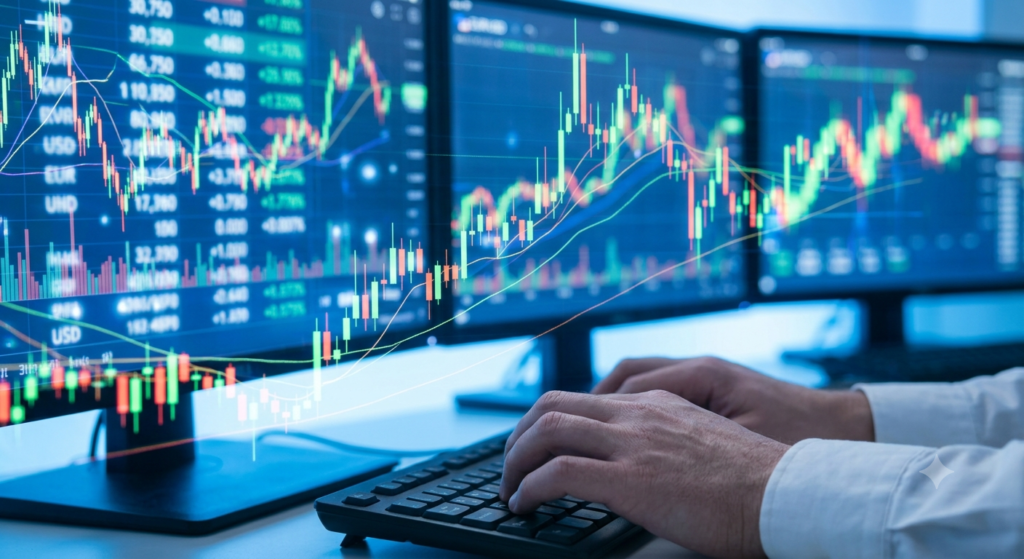
- Pips: The smallest price move a currency pair can make. Usually, it is the fourth decimal place (0.0001).
- Spread: The difference between the buy price and the sell price. This is how your broker makes a profit.
- Lot: The standardized size of a Forex trade. A standard lot equals 100,000 units of currency
Leverage: A Double-Edge Sword

Forex brokers allow you to trade using leverage. This means you can control large positions with a very small deposit. For example, 1:100 leverage lets you control $100,000 with just $1,000. While leverage multiplies your potential profits, it also multiplies your potential losses just as fast.
How People Actually Make Money in Forex?
Traders profit from the constant fluctuations in exchange rates. Imagine you buy €10,000 when the EUR/USD exchange rate is 1.10. Your trade is worth $11,000.
A week later, the Euro strengthens, and the exchange rate climbs to 1.12. If you sell your Euros back for Dollars, your position is now worth $11,200. You just made a clean $200 profit from the exchange rate shift.
The Risks: Why Most Beginners Lose Money
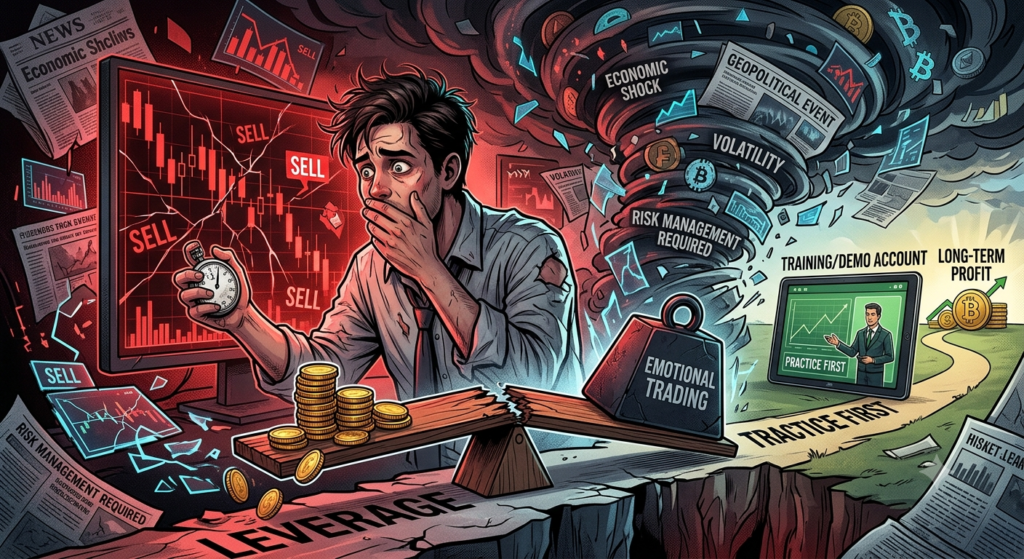
The Forex market moves fast. Economic reports, geopolitical events, and central bank decisions can trigger massive, unpredictable price swings in seconds.
Because of high leverage and emotional trading, the vast majority of retail beginners lose money. To survive, you must master trading risk management before risking real cash. Always practice on a free demo account before risking your hard-earned capital.
Key Players in the Forex Market
Understanding who moves the market helps you predict major price changes.
- Central Banks: Federal Reserve, ECB, and BOJ manage money supply and interest rates.
- Commercial Banks: Mega-banks like JPMorgan and Citi handle the highest trading volume.
- MNCs: Multinational corporations swap huge currency volumes to pay global business costs.
- Retail Traders: Individual investors like you trading via online brokerage accounts.
Types of Forex Market Analysis
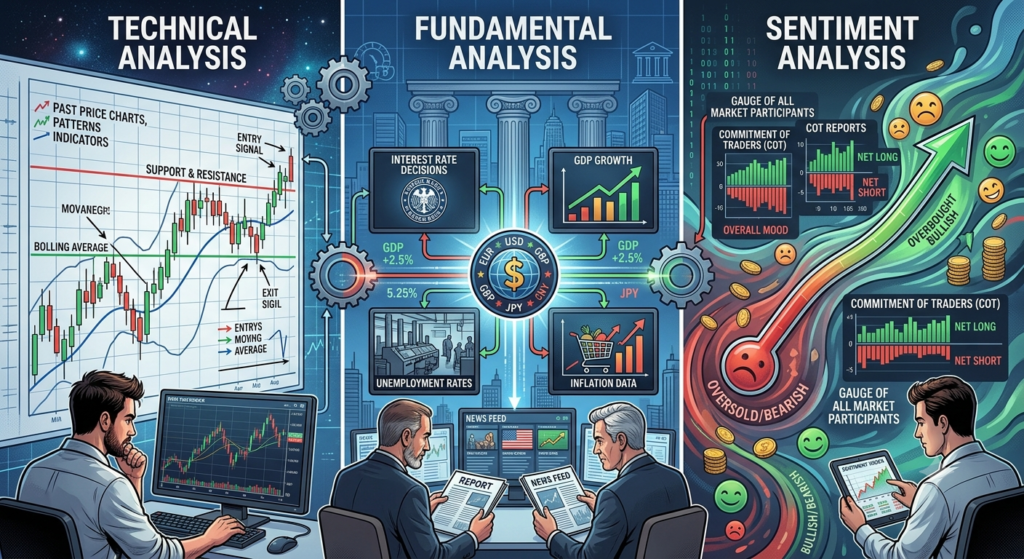
To profit in Forex, you must learn how to predict currency movements using three methods:
Technical Analysis
- Definition: Studying past price charts, patterns, and indicators to predict future trends.
- Key Tools: Support & Resistance lines, Candlestick patterns, Moving Averages.
- Goal: Finding the right entry and exit points based on historical data.
Fundamental Analysis
- Definition: Analyzing economic indicators, health of a country, and political stability.
- Key Drivers: Interest rate decisions, GDP growth, Unemployment rates, Inflation data.
- Goal: Figuring out whether a currency is undervalued or overvalued.
Sentiment Analysis
- Definition: Gauging the overall mood and feeling of all market participants
- Key Indicator: Commitment of Traders (COT) reports showing net long/short positions.
- Goal: Identifying if the market is overly bullish or bearish to avoid traps.
The Three Types of Forex Markets
Forex trading does not happen in just one way; it is split into three distinct market types:
- Spot Market: The physical exchange of currency pairs happening instantly at the current price.
- Forward Market: Binding contracts to buy/sell a currency at a set price on a future date.
- Futures Market: Standardized forward contracts traded on public exchanges like Chicago Mercantile Exchange (CME).
Common Mistakes Beginners Must Avoid
Protect your trading capital by actively avoiding these four psychological and execution traps:
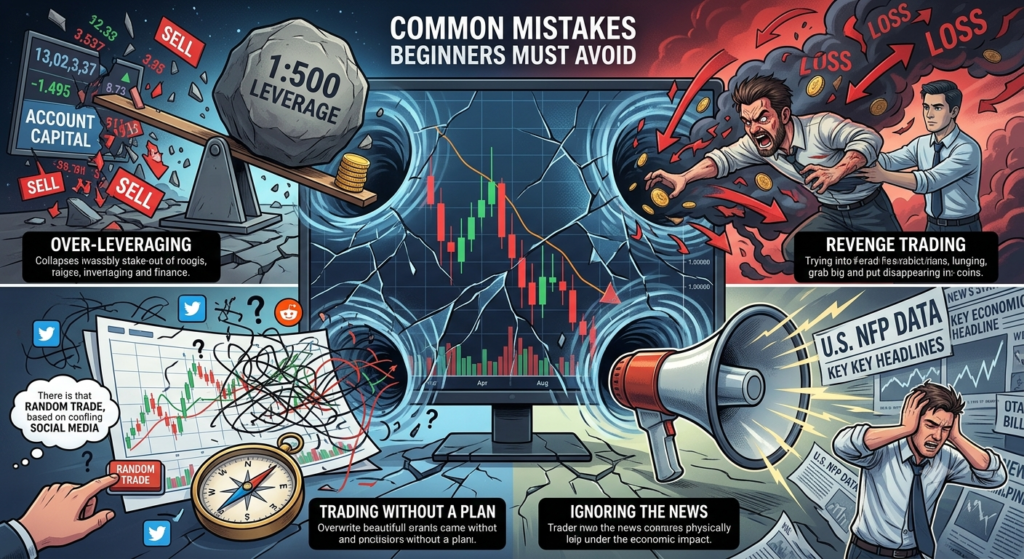
- Over-leveraging: Using excessive leverage that wipes out your account on a small price move.
- Revenge Trading: Trying to aggressively win back lost money immediately after a losing trade.
- Trading Without a Plan: Entering positions based on random gut feelings or social media hype.
- Ignoring the News: Trading blindly during high-impact economic news releases like U.S. NFP data.
Essential Tools Every Forex Trader Needs
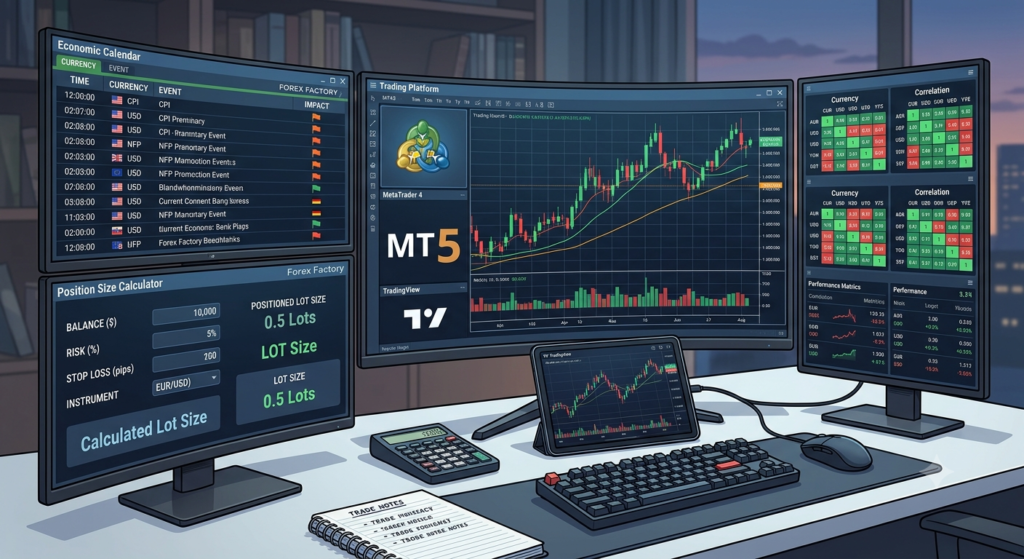
To trade professionally, you must integrate these vital utilities into your daily workflow:
- Trading Platform: Standard software like MetaTrader 4 (MT4), MetaTrader 5 (MT5), or TradingView.
- Economic Calendar: Free trackers on websites like Forex Factory to monitor daily financial news events.
- Position Size Calculator: Tools to calculate exact lot sizes based on your risk tolerance.
Frequently Asked Questions (FAQs)
1. What is the minimum amount needed to start Forex trading?
- You can start with as little as $10 to $100 using a micro or nano account.
- Starting small allows you to practice live trading execution without risking large capital.
2. Is Forex trading legal and safe?
- Forex trading is completely legal in most countries around the world.
- Safety depends entirely on choosing a reputable broker regulated by tier-1 authorities (like FCA or ASIC).
3. How is Forex different from the Stock Market?
- Forex operates 24 hours a day, 5 days a week, while stocks have rigid market hours.
- The Forex market offers much higher liquidity and higher leverage options than stocks.
4. Can I lose more money than I deposit in Forex?
- Yes, high leverage can theoretically push your account into a negative balance.
- Most modern regulated brokers offer Negative Balance Protection to prevent your account from dropping below zero.
5. What are the best currency pairs for beginners to trade?
- Beginners should stick to “Major Pairs” like EUR/USD, GBP/USD, and USD/JPY.
- These pairs offer the lowest spreads, highest liquidity, and most predictable price movements.
6. How much money can a beginner make in Forex?
- Profits vary widely based on your skills, risk management, and initial capital.
- Focus on consistent percentage gains (e.g., 2% to 5% monthly) rather than trying to get rich overnight.
Conclusion
Forex trading is not a shortcut to instant wealth, but a skill that requires discipline, patience, and continuous learning. The market offers massive financial opportunities, but only to those who treat it as a professional business rather than a casino.
Before risking your hard-earned money, download a trading platform, open a free demo account, and practice until you can consistently protect your capital. Master your emotions, stick to your risk limits, and let data guide your trades.
Risk Disclaimer
- High-Risk Warning: Trading foreign exchange (Forex) on margin carries a high level of risk and may not be suitable for all investors. The high degree of leverage can work against you as well as for you.
- Potential for Loss: Before deciding to trade foreign exchange, you should carefully consider your investment objectives, level of experience, and risk appetite. The possibility exists that you could sustain a loss of some or all of your initial investment.
- Not Financial Advice: The information provided in this guide is for educational purposes only and does not constitute investment or financial advice. Always consult with a certified financial advisor before making any investment decisions.