Have you ever looked at the stock market and wondered how people actually make money from it? You have likely heard terms like day trading and long-term investing thrown around in financial news or social media. While both methods can help you build wealth, they are completely different animals.
Choosing the wrong approach for your personality, budget, or financial goals can lead to unnecessary risk and lost money.
The main difference comes down to time and strategy. Traders look at the stock market as a fast-paced arena to capture quick profits over days, hours, or even minutes. Investors view the market as a long-term savings vehicle, buying pieces of great businesses and holding onto them for years or decades.
This comprehensive guide breaks down everything you need to know about trading versus investing. We will explore the mechanics, risks, rewards, and costs of each path so you can confidently decide which strategy fits your financial future.
The Core Definitions: Trading vs Investing
To understand how these two financial paths operate, let’s look at their core definitions and primary mechanics.
+-------------------------------------------------------------------+

|                           THE BIG PICTURE                         |
+-------------------------------------------------------------------+

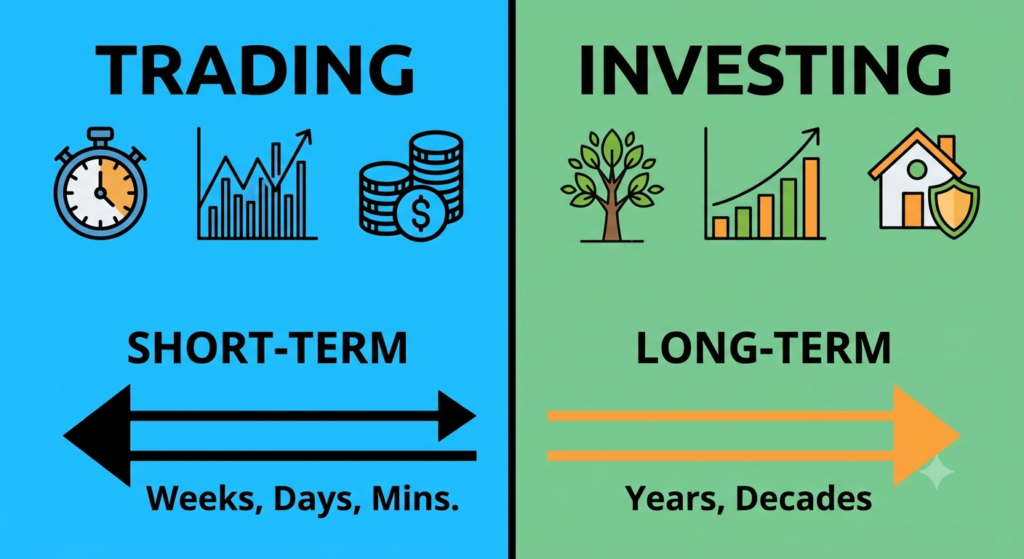
|  TRADING: Capturing short-term price changes (Weeks, Days, Mins)  |
|  INVESTING: Building long-term wealth via growth (Years, Decades) |
+-------------------------------------------------------------------+
What Is Trading?
Trading is the active buying and selling of financial assets over short periods to capitalize on price fluctuations. Traders do not care whether a company is changing the world or has a flawless balance sheet. They only care if the price is moving.
A trader might buy a stock at $50 in the morning and sell it at $52 by lunchtime. Success in trading relies on high volume, precise timing, and strict risk management.
What Is Investing?
Investing is the strategy of buying and holding assets for an extended period, typically years or decades. Investors focus on the underlying value of the asset. When you invest in a stock, you are buying a tiny piece of a real business.
Investors trust that if the company performs well over time, its stock price will eventually rise to reflect that value. They also benefit from compounding returns and regular dividend payouts.
Side-by-Side Comparison: Quick Summary
If you are short on time, here is a scannable snapshot of how trading and investing stack up against each other across key metrics.
| Feature | Trading | Investing |
|---|---|---|
| Time Horizon | Short-term (minutes, days, weeks) | Long-term (years, decades, generations) |
| Primary Goal | Generate quick profits from price swings | Accumulate wealth through compound growth |
| Risk Level | High (potential for sudden, large losses) | Moderate (mitigated by time and diversification) |
| Analysis Style | Technical analysis (charts, trends, indicators) | Fundamental analysis (earnings, management, industry) |
| Transaction Frequency | Very high (dozens of trades per week or day) | Very low (few transactions per month or year) |
| Tax Impact | High short-term capital gains tax rates | Lower long-term capital gains tax benefits |
| Time Commitment | High (requires constant daily market monitoring) | Low (requires occasional portfolio rebalancing) |
| Core Psychology | Disciplined, fast-acting, high stress tolerance | Patient, unemotional, focused on big picture |
Detailed Breakdown of Trading
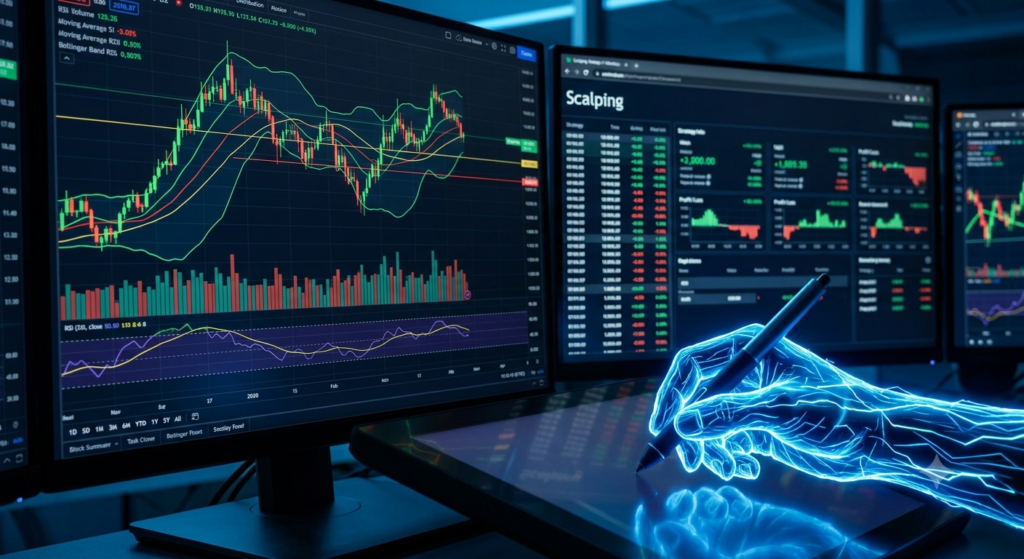
To succeed as a trader, you need to think like a short-term strategist. Let’s dive into the core mechanics, styles, and tools that define the trading world.
       [Trader's Focus: Price Action & Market Sentiment]
                             │
       ┌─────────────────────┼─────────────────────┐
       ▼                     ▼                     ▼
[Scalping]             [Day Trading]        [Swing Trading]
Seconds to Minutes     Hours (Close Daily)   Days to Weeks
1. Short-Term Time Horizons
Traders live in the present. They do not care where a stock will be in five years. Instead, they look at where the price is heading over the next five minutes or five days. Because their windows are so small, they must execute transactions quickly to protect their capital or lock in a gain.
2. The Power of Technical Analysis
Traders rarely read annual reports or corporate balance sheets. Instead, they rely heavily on technical analysis. This involves studying historical price charts, volume indicators, and mathematical patterns. Common tools include:
- Moving Averages: Tracking average prices over specific windows to identify trends.
- Relative Strength Index (RSI): Measuring if a stock is overbought or oversold.
- Support and Resistance Levels: Identifying price points where a stock historically struggles to fall below or rise above.
3. Common Trading Styles
Not all traders operate at the same speed. The industry generally breaks down into four main styles:
- Scalping: The fastest style of trading. Scalpers hold stocks for seconds or minutes, aiming to capture tiny price movements. They may execute hundreds of trades a day.
- Day Trading: Day traders buy and sell assets within a single market day. They close out all positions before the market rings its final bell to avoid unexpected news overnight.
- Swing Trading: Swing traders hold positions for days or weeks. They look for short-term market trends or “swings” triggered by corporate events, earnings releases, or macroeconomic news.
- Position Trading: The longest form of trading. Position traders hold assets for weeks or months, following macro trends rather than daily price noise.
4. Leverage and Margin Accounts
Traders often use leverage to boost their profits. By using a margin account, they borrow capital from their broker to buy more shares than their cash balance allows.
While leverage can turn a small 2% price move into a massive profit, it can also amplify losses. If a leveraged trade goes against you, you can lose more money than your initial deposit.
Detailed Breakdown of Investing

Investing takes a fundamentally different view of the financial world. It requires you to step back from daily market noise and focus on long-term corporate health.
       [Investor's Focus: Intrinsic Value & Growth]
                             │
       ┌─────────────────────┼─────────────────────┐
       ▼                     ▼                     ▼
[Value Investing]      [Growth Investing]   [Index/Passive]
Underpriced Stocks     High-Growth Firms    Broad Market Tracking
1. Long-Term Time Horizons and Compounding
Investors measure their success in years and decades. This long-run approach unlocks the most powerful force in finance: compound interest. When your investments earn returns, those returns generate their own earnings. Over decades, this snowball effect transforms modest savings into significant wealth.
2. The Depth of Fundamental Analysis
Investors use fundamental analysis to evaluate assets. They look under the hood of a company to measure its financial health and future potential. Key data points include:
- Earnings Reports: Checking if revenue and net income are growing consistently.
- Price-to-Earnings (P/E) Ratio: Determining if a stock is fairly priced relative to its profits.
- Debt Levels: Ensuring a company isn’t carrying too much liability.
- Competitive Moats: Analyzing if a business has a unique advantage (like a strong brand or proprietary tech) that protects it from competitors.
3. Common Investing Styles
Just like trading, investing features diverse philosophies:
- Value Investing: Made famous by Warren Buffett, this style involves looking for unloved, underpriced stocks trading for less than their actual worth.
- Growth Investing: This style focuses on young, rapidly expanding companies. Growth stocks often reinvest all their profits into expansion rather than paying dividends.
- Income Investing: This strategy prioritizes steady cash flow. Income investors buy corporate bonds, real estate investment trusts (REITs), and dividend-paying stocks.
- Index/Passive Investing: Instead of picking individual stocks, passive investors buy index funds or Exchange-Traded Funds (ETFs). These funds track an entire market index, like the S&P 500, offering instant diversification.
Risk vs. Reward: Two Different Worlds
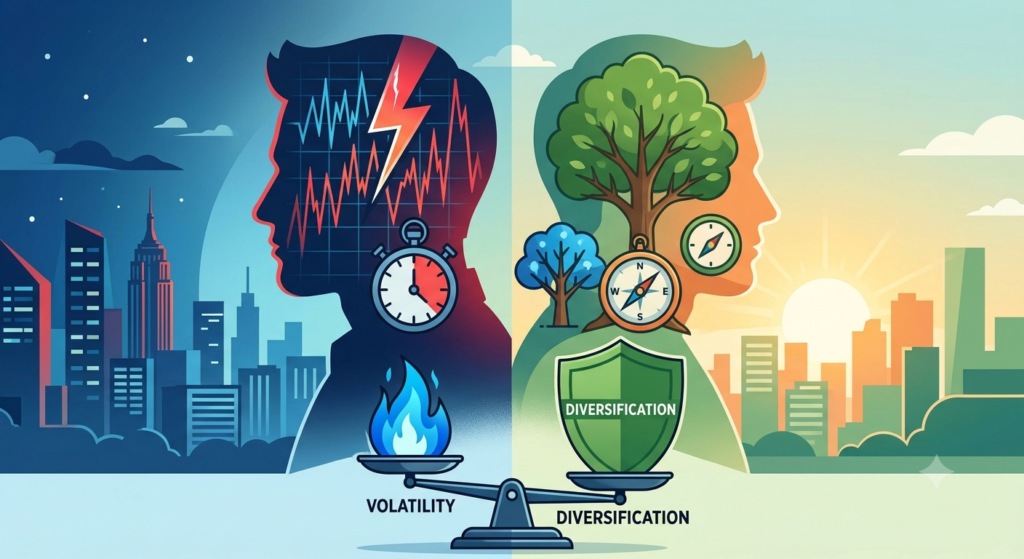
Every financial decision involves a trade-off between risk and reward. Understanding this balance is vital before committing your capital.
RISK PROFILE COMPARISON:

Trading:   [████████████████████] High Volatility / Active Management
Investing: [████████░░░░░░░░░░░░] Managed Volatility / Time Cushion
The Trading Risk Profile
Trading carries a steep learning curve and significant risk. Because trades happen fast, unexpected news—like a surprise regulatory change or a CEO departure—can crash a stock’s price in seconds.
Traders also face execution risks, such as slippage, where a order fills at a worse price than expected during volatile markets. Academic studies consistently show that the vast majority of retail day traders lose money over time due to emotional choices and transaction fees.
The Investing Risk Profile
Investing is not risk-free, but its hazards are different. Investors face market risk—the reality that the entire stock market falls during recessions or bear markets.
However, investors use time to neutralize this risk. While the stock market experiences sharp down years, its long-term trajectory over decades has historically been upward. By holding through downturns, investors give their portfolios time to recover.
Risk Mitigation Strategies
Both camps use specific toolkits to control losses:
- Traders use Stop-Loss Orders: This is an automatic instruction to sell a stock if its price drops to a specific level, preventing catastrophic losses.
- Investors use Diversification: By spreading money across hundreds of different stocks, industries, and asset classes, investors ensure that one failing company cannot ruin their entire portfolio.
The Financial Costs: Fees, Commissions, and Taxes
Making money in the market is only half the battle; you also need to keep it. Fees, friction costs, and taxes can quietly eat away at your returns if you are not careful.
COST DRIVERS:

Trading:   [Transaction Fees] + [Bid-Ask Spreads] + [Short-Term Capital Gains Tax]
Investing: [Low Management Fees (Expense Ratios)] + [Long-Term Capital Gains Tax]
Transaction Costs and Spreads
Every time you buy or sell a stock, it can trigger financial costs. While many modern brokers offer zero-commission trading on stocks, traders still face the bid-ask spread. This is the difference between the highest price a buyer is willing to pay and the lowest price a seller will accept.
For active traders executing dozens of transactions a week, these tiny spread fractions add up to significant friction costs. Investors trade infrequently, making these spreads irrelevant to their bottom line.
The Impact of Capital Gains Taxes
Taxes work differently depending on how long you hold an asset. This is a critical distinction for your net returns:
- Short-Term Capital Gains (Trading): If you buy and sell an asset in under a year, your profits are taxed as ordinary income. Depending on your tax bracket, this rate can be significantly higher than investment tax rates.
- Long-Term Capital Gains (Investing): If you hold an asset for more than a year before selling, your profits qualify for long-term capital gains tax rates. These rates are substantially lower, helping you keep more of your returns.
Psychological Profiles: Which One Fits You?
Your financial success depends heavily on your personality, emotional discipline, and daily schedule.
+-----------------------------------------+---------------------------------------------------+
|          THE TRADER PROFILE             |        THE INVESTOR PROFILE                       |
+-----------------------------------------+---------------------------------------------------+
| • Comfortable with rapid decisions      | • Patient and forward-thinking                    |
| • Thrives under high-stress environment | • Able to ignore short-term noise                 |
| • Can dedicate hours to active screens  | • Prefers automation and set-and-forget           |
| • Views losses as business expenses     | • Focuses on business fundamentals                |
+------------------------------------+--------------------------------------------------------+
The Psychology of a Successful Trader
To survive as a trader, you need emotional detachment and quick decision-making skills. You must accept that losing individual trades is a normal cost of doing business.
Traders cannot afford to freeze when a trade goes wrong; they must execute their stop-loss orders immediately. If you have an impulsive personality or panic when losing money, active trading can lead to stressful decision-making.
The Psychology of a Successful Investor
Investing requires patience and the ability to tune out daily market commentary. The hardest part of investing is doing nothing. When the market drops during a correction, a successful investor stays calm, keeps buying, and avoids selling in a panic.
If you prefer a structured, “set-it-and-forget-it” system that runs quietly in the background while you focus on your career and family, investing is your natural match.
Hybrid Approaches: Can You Do Both?
You do not have to choose one strategy and abandon the other completely. Many wealth builders successfully blend trading and investing using a core-and-satellite system.
                  +--------------------------------+
                  |    CORE INVESTING PORTFOLIO    |
                  |             (80-90%)           |
                  |  Long-Term ETFs, Index Funds,  |
                  |      Blue-Chip Stocks          |
                  +---------------+----------------+
                                  |
                                  v
                  +--------------------------------+
                  |  SATELLITE TRADING PORTFOLIO   |
                  |             (10-10%)           |
                  | Active Trading, Short-Term Bets|
                  +--------------------------------+
The Core-and-Satellite Strategy
In this framework, you allocate the vast majority of your capital (80% to 90%) to a core investment portfolio filled with broad-market index funds, target-date funds, or blue-chip dividend stocks. This money handles your long-term goals, like retirement or a house down payment.
You then place the remaining 10% of your funds into a separate “satellite” account for active trading. This setup lets you learn short-term trading strategies and take calculated risks without endangering your underlying financial security.
Action Plan: How to Get Started Safely
Regardless of which path you choose, entering the market requires a clear, deliberate sequence of actions. Follow this step-by-step roadmap to build a secure foundation.
Step 1: Secure Your Foundation
Before placing a single dollar into the market, build a financial safety net:
- Pay off high-interest debt: Eliminate any debt with an interest rate above 7-8% (like credit cards).
- Build an emergency fund: Set aside three to six months’ worth of living expenses in a liquid account.
Step 2: Choose Your Account Type
Select a brokerage account tailored to your long-term goals:
- For Investors: Prioritize tax-advantaged accounts like a 401(k) or an Individual Retirement Account (IRA) to shelter your returns from taxes.
- For Traders: Open a standard taxable brokerage account with a platform that offers fast execution speeds, advanced charting features, and clear margin terms.
Step 3: Paper Trade First (For Traders)
If you want to trade, start with a simulator or paper trading account. These platforms let you practice with fake money in live market conditions. Do not risk real capital until you have proved your strategy works over several months of simulated trading.
Step 4: Automate Your Strategy (For Investors)
If you choose investing, set up Dollar-Cost Averaging (DCA). Configure your account to automatically invest a fixed amount of money every week or month into your chosen funds. This ensures you buy shares regularly, regardless of whether prices are temporarily up or down.
Frequently Asked Questions (FAQ)
Is trading or investing more profitable?
Neither method is guaranteed to make more money. Investing offers reliable, consistent returns over long periods with low upkeep. Trading has the theoretical potential for higher short-term returns, but its actual failure rate is significantly higher due to leverage, volatility, and emotional errors.
Can you start trading or investing with little money?
Yes. Thanks to fractional shares and zero-fee brokerage accounts, you can start investing or trading with as little as $1 to $10. Many broad market ETFs are highly accessible to beginners with small balances.
Is day trading considered a type of investing?
No. Day trading is completely different from investing. Day traders look at short-term price charts and close out positions within hours. Investors buy shares based on corporate value and hold them for multiple years.
What are the tax implications of trading vs. investing?
Traders generally pay higher short-term capital gains taxes because they hold assets for less than a year. Investors benefit from lower long-term capital gains tax rates by holding assets for more than twelve months before selling.
Can I use the same brokerage account for both trading and investing?
You can, but it is rarely a good idea. Combining them makes it difficult to track your true performance and increases the risk of accidentally spending your long-term savings on a risky short-term trade. It is safer to keep them in separate accounts.
Final Review: Making Your Final Choice
To choose your path, look at your primary constraints: time, capital, and personality.
+--------------------------------------------------------------------------+
|                            WHICH PATH IS YOURS?                          |
+--------------------------------------------------------------------------+
| CHOOSE TRADING IF:        You have hours daily, love analysis, tolerate  |
|                           high stress, and want active income.           |
|                                                                          |
| CHOOSE INVESTING IF:      You want automated wealth, have a long horizon,|
|                           and prefer peace of mind over excitement.      |
+--------------------------------------------------------------------------+
Market participation is not about finding the “perfect” strategy; it is about finding the strategy you can stick with during volatile times.
If you love analytical puzzles, fast decisions, and can handle regular losses, exploring trading via a small satellite account can be educational. If you want to build steady wealth while focusing your energy on your family, career, and life, long-term investing is your best option.