1. Introduction
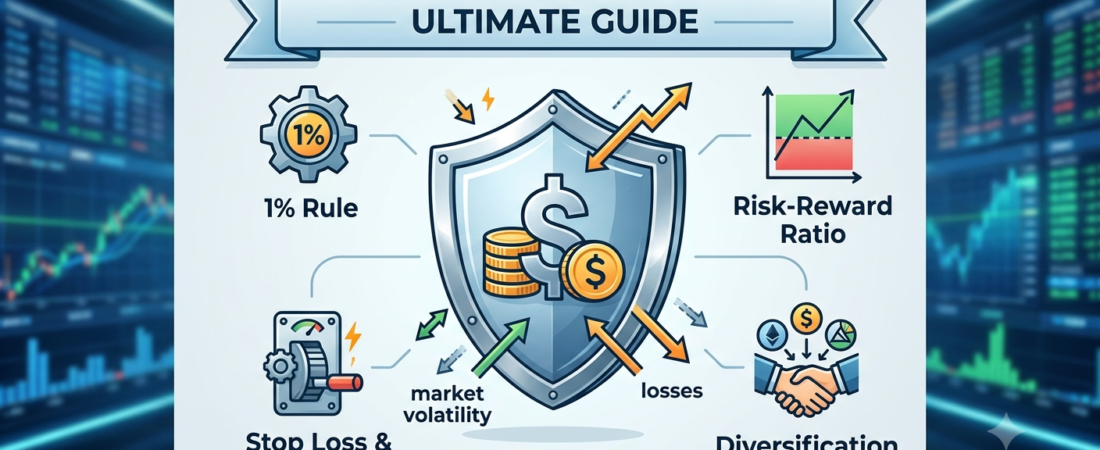
Trading risk management is the foundational pillar that separates consistently profitable market professionals from emotional gamblers who completely destroy their accounts. Every single time you execute an order, you open your hard-earned capital to unpredictable, rapid price fluctuations.
Many beginners make the mistake of focusing exclusively on finding a perfect entry signal or a “holy grail” technical indicator. However, experienced professional traders realize that masterfully executing your trading risk management plan matters significantly more than your directional accuracy.
2. What Is Risk Management?
Trading risk management is a structured framework of rules, tools, and psychological practices designed to limit financial losses. It is not about avoiding risk entirely. Without risk, there is no reward.
Instead, risk management is about controlling the downside. It ensures that no single trade, or string of bad trades, can wipe out your account. It changes trading from reckless gambling into a structured, statistical business.
3. Why Risk Management Is Important
Without strict risk controls, a mathematical reality called the asymmetric mathematical recovery law will destroy your account. When you lose capital, the percentage gain required to get back to even grows exponentially.
| Account Loss (%) | Recovery Gain Required to Break Even (%) |
|---|---|
| 10% | 11% |
| 20% | 25% |
| 30% | 43% |
| 50% | 100% |
| 90% | 900% |
If you lose 50% of your account, you must double your remaining money just to get back to where you started. Protecting your capital prevents you from falling into these deep mathematical holes. [1]
4. Types of Risk in Trading
To protect your money, you must understand what you are fighting against. Traders face several distinct types of financial risk:
- Market Risk: The danger of asset prices moving aggressively against your open position.
- Liquidity Risk: The inability to exit a trade at your desired price due to a lack of buyers or sellers.
- Leverage Risk: The magnification of losses caused by trading with borrowed broker funds.
- Execution Risk: Slippage or technical delays that fill your order at a worse price than expected.
- Overnight Risk: Unexpected news or market gaps that occur while the market is closed.
5. Principles of Risk Management
Long-term survival rests on three foundational pillars:
- Capital Preservation First: Your primary goal is staying in the game; making money comes second.
- Consistency Over Luck: Trade with a fixed, repeatable process rather than emotional impulses.
- Accepting Statistical Reality: Accept that losses are a normal cost of doing business.
6. Position Sizing Explained
Position sizing dictates exactly how many shares, contracts, or lots you buy. It is the most vital variable in your trading plan.
The 1% Rule
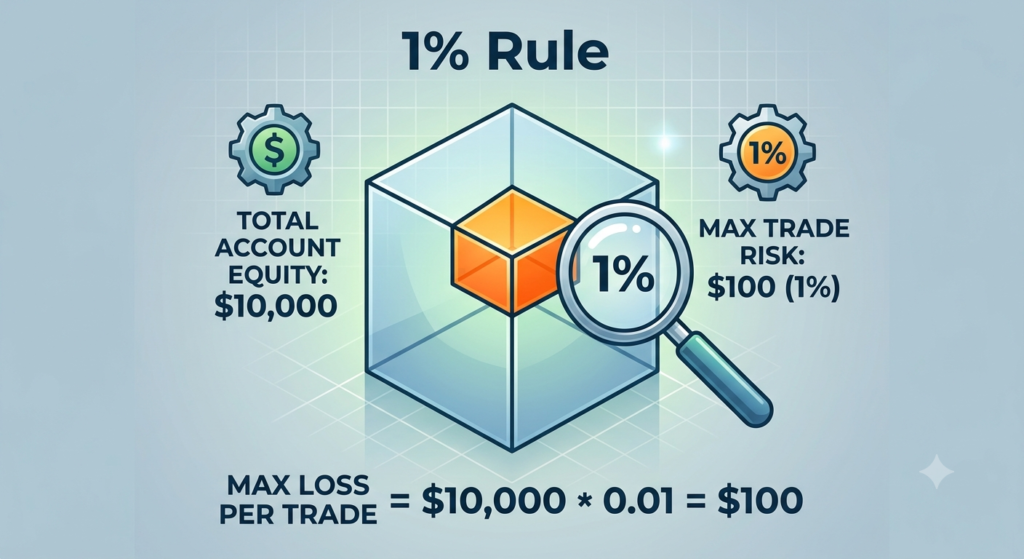
Never risk more than 1% of your total account equity on a single trade. If you have a $10,000 account, your maximum legal loss per trade is $100.
Position Sizing Formula
To find your exact trade size, use this mechanical formula:
Position Size = Account Risk Dollars/Distance to Stop Loss
For example, if you risk $100 on a stock, and your stop-loss is $2 away from your entry price, you can buy exactly 50 shares ($100 / $2).
7. Risk-to-Reward Ratio
The Risk-to-Reward Ratio (R:R) measures your potential profit against your potential loss.
- A 1:2 R:R means you risk $100 to make $200.
- Aiming for a minimum of 1:2 allows you to remain highly profitable even with a low win rate.
The Math of R:R
If you use a 1:2 ratio, you only need to win 34% of your trades to break even. If you use a 1:3 ratio, your required win rate drops to just 26%.
8. Stop Loss & Take Profit
Orders must be placed directly into your broker platform, not kept in your head.
- Hard Stop Loss: A mechanical order that automatically exits your trade at a predetermined price to cap your losses.
- Trailing Stop Loss: A dynamic stop that moves higher as the price climbs, locking in open profits.
- Take Profit Order: A target order that closes your trade automatically when your profit goal is hit.
9. Diversification Strategies
Putting all your capital into one asset invites disaster. True diversification spreads your risk across uncorrelated spaces.
- Asset Class Splits: Divide capital between stocks, forex, commodities, and crypto.
- Sector Diversification: Avoid holding five tech stocks at once; mix in healthcare, energy, or financials.
- Correlation Tracking: Ensure your open positions do not move in perfect tandem, which doubles your risk exposure.
10. Trading Psychology and Risk
Mastering risk requires mastering your own mind. Emotional biases break even the best statistical models.
- FOMO (Fear of Missing Out): Forces you to chase overextended prices, ruining your R:R.
- Revenge Trading: Spurring immediate, aggressive trades after a loss to try and win the money back.
- Greed: Moving your profit targets further away dynamically, causing winning trades to turn into losses.
11. Common Risk Management Mistakes
Avoid these frequent trading traps:
- Widening Stop Losses: Moving your stop lower during a trade because you “hope” it will turn around.
- Over-leveraging: Using massive margin that can wipe out your account on a single market tick.
- Trading Without a Plan: Figuring out your exit parameters after you are already exposed to the market.
12. Risk Management Strategies for Beginners
If you are just starting out, follow this simple roadmap:
- Use a Demo Account: Paper trade for at least three months to test your risk tools risk-free.
- Cap Your Leverage: Keep your leverage below 1:3 while you are learning the ropes.
- Log Everything: Maintain a detailed trading journal tracking your entry, exit, R:R, and emotional state.
13. Advanced Risk Management Techniques
Experienced traders use sophisticated tools to optimize performance:
- Average True Range (ATR): Set stops based on current market volatility rather than arbitrary dollar amounts.
- Value at Risk (VaR): Statistical modeling to estimate maximum potential portfolio loss over a set timeframe.
- Hedging: Opening offsetting options or futures positions to protect an active portfolio from market shocks.
14. Practical Real-World Examples
Example A: The Unmanaged Trade (The Gambler)
- Account Balance: $10,000
- Trade: Buys $8,000 worth of a volatile stock with no stop loss.
- Outcome: Bad earnings drop the stock by 40%. The trader panics and sells, losing $3,200 (32% of their entire account).
Example B: The Managed Trade (The Professional)
- Account Balance: $10,000
- Risk Limit: 1% ($100)
- Trade: Buys stock at $100, sets a hard stop loss at $95.
- Position Size: 20 shares ($100 / $5 risk per share).
- Outcome: The same bad earnings drop the stock by 40% overnight. The trade exits at the stop level, losing just $100 (1% of the account).
15. Frequently Asked Questions
Q1: What is the single best Trading risk management strategy?
The absolute best strategy is the 1% risk rule combined with a mechanical stop loss.
Q2: Can I trade successfully without a stop loss?
No. Unforeseen market black swan events will eventually clear out an account that lacks hard stops.
Q3: How do I calculate my risk-to-reward ratio?
Divide your potential net profit by your potential maximum loss.
Q4: Is a 1:1 risk-to-reward ratio acceptable?
Only if your win rate is sustainably above 60%. For beginners, 1:2 or higher is much safer.
Q5: What is slippage in trading?
Slippage is the difference between your requested stop price and the actual execution price during fast markets.
Q6: How many trades should I have open at once?
Keep active exposure to 3–5 highly uncorrelated positions to maintain focus and control.
Q7: Should I use mental stop losses?
No. Emotions usually override mental stops, causing you to hold losing positions far too long.
Q8: What does drawdown mean?
Drawdown is the peak-to-trough decline in your trading account balance during a losing streak.
Q9: How does leverage affect risk?
Leverage multiplies your buying power, which proportionally magnifies both your winning and losing sizes.
Q10: What is the Kelly Criterion?
A mathematical formula used to determine optimal bet sizes based on win rate and payout ratios. [1, 2]
Q11: How do I manage risk during high-impact news?
The safest approach is to flatten your positions or widen stops before major macroeconomic releases.
Q12: What is correlation risk?
Holding multiple positions that react identically to the same market events, concentrating your true risk.
Q13: How do I handle a prolonged losing streak?
Cut your trading size in half, or return to a demo account until your edge returns.
Q14: What is an equity curve?
A graphic chart displaying the performance and financial health of your trading account balance over time.
Q15: Should I risk more money when I am on a winning streak?
No. Maintain consistency; scalping up arbitrarily due to overconfidence leads to massive drawdowns.
16. Conclusion
Trading risk management is the true dividing line between systemic profitability and sudden bankruptcy. By automating your position sizes, respecting the 1% rule, and letting your stop-losses run without emotional interference, you build a sustainable career. Protect your downside, and your upside will take care of itself.
Financial Disclaimer
Disclaimer: Trading financial instruments involves high risk. This material is for educational purposes only and does not constitute explicit investment advice.