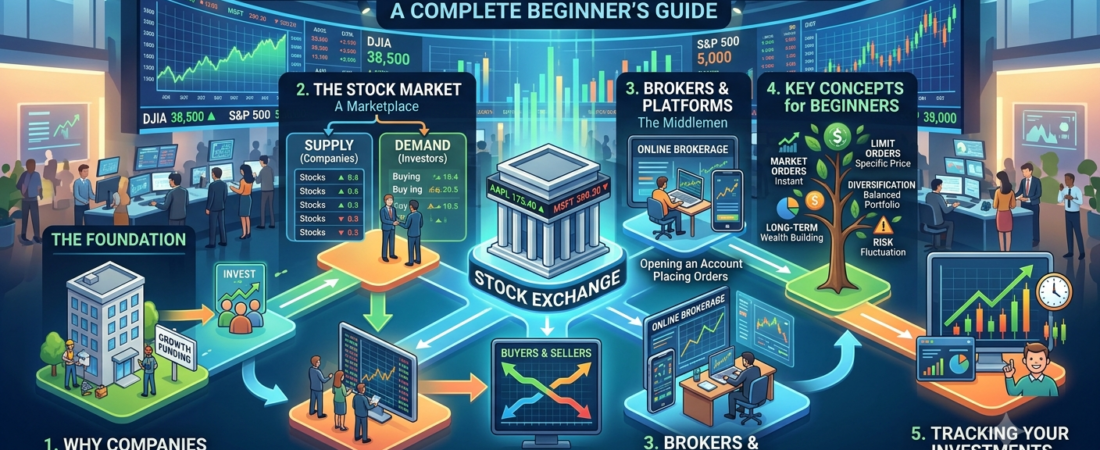
Imagine walking into a massive global marketplace where tiny pieces of the world’s greatest corporations change hands every millisecond. The lights are flashing, numbers flip instantly, and wealth is built over time. It can look like an intimidating wall of numbers, but beneath the jargon, the stock market runs on a few surprisingly straightforward principles.
Understanding how the stock market works is your ultimate ticket to financial freedom. This comprehensive, step-by-step guide will demystify the stock market, strip away the confusing Wall Street terminology, and give you the practical knowledge you need to build long-term wealth confidently.
Table of Contents
- What Is the Stock Market?
- Why the Stock Market Exists
- How the Stock Market Works (Step-by-Step)
- Primary Market vs. Secondary Market
- Stock Exchanges Explained
- Major Stock Market Participants
- Types of Stocks
- What Makes Stock Prices Move?
- Trading vs. Investing
- How Beginners Can Start Investing
- Benefits of Investing in the Stock Market
- Risks of the Stock Market
- Common Beginner Mistakes
- Tips for Long-Term Success
- Frequently Asked Questions
What Is the Stock Market?
The stock market is an interconnected network of exchanges where investors buy and sell shares of publicly traded companies. Think of it as a digital auction house. Instead of auctioning off physical antiques or art pieces, participants bid on fractional ownership stakes in businesses.
When you buy a share of stock, you are buying a tiny piece of equity in that company. If a company has 1 million shares outstanding and you buy 10,000 shares, you own exactly 1% of that business. As a part-owner, you gain exposure to the company’s future financial success, which typically comes in two forms: capital appreciation (the stock price going up) and dividends (cash distributions of company profits).
Historically, the stock market was a physical room—like the iconic trading floor of the New York Stock Exchange—where traders shouted orders at each other. Today, the modern stock market operates almost entirely via electronic networks, allowing a retail investor in California or an institutional fund in Tokyo to execute transactions instantly at the tap of a screen.
Why the Stock Market Exists?
The stock market serves as an essential economic engine by solving two distint problems at once:
1. Corporate Capital Formation
Growing businesses require massive amounts of cash to fund research and development, build infrastructure, or expand into new global territories. Instead of taking on expensive corporate debt or bank loans, companies choose to sell a portion of their equity to the public. This equity financing gives them access to non-repayable capital to fuel growth.
2. Public Wealth Creation
For individual citizens, the stock market provides a democratic path to participate in the wealth generated by the world’s most profitable companies. Instead of inventing a groundbreaking product or launching a massive corporation yourself, you can deploy your savings to buy fractional shares of existing, highly optimized businesses and profit from their long-term expansion.
How the Stock Market Works (Step-by-Step)
Modern equity trading happens at lightning speed through complex electronic matching systems. Here is exactly how a transaction flows from your computer screen to final execution:
[Investor Allocates Funds]
│
▼
[Order Entry via Broker] ──► (Market vs. Limit Order Selection)
│
▼
[Order Sent to Exchange] ──► (Matching Engine Pairs Buyer & Seller)
│
▼
[Trade Execution] ─────────► (Price Transmitted to Ticker Tape)
│
▼
[Clearing & Settlement] ───► (Shares & Cash Transferred via Demat)
1. Account Setup & Capitalization: An investor chooses a regulated brokerage platform, completes identity verification, and deposits capital from a traditional bank account.
2. Order Formulation: The investor selects a specific ticker symbol (such as Apple’s AAPL or Microsoft’s MSFT) and enters a specific order parameter. They choose between buying immediately at current prices or waiting for a specific target value.
3. Electronic Transmission: The brokerage software routes the request to a centralized digital order book managed by a formal stock exchange.
4. Automated Matching Engine: High-speed algorithmic computer networks analyze thousands of global buy and sell orders concurrently, matching matching prices instantaneously.
5. Trade Execution: Once a complementary matching party is secured, the exchange executes the transaction, locking in the final trade price.
6. Clearing and Settlement: In modern financial markets, securities clear through an official depository. Cash is debited from the buyer and credited to the seller, while ownership records are formally updated on the digital registry, typically completed within one business day (\(T+1\) settlement cycle).
Primary Market vs. Secondary Market
Equity transactions are split across two entirely separate functional layers:
| Feature | Primary Market | Secondary Market |
|---|---|---|
| Core Function | Issuing brand-new shares for the first time. | Trading existing pre-owned shares among investors. |
| Primary Mechanism | Initial Public Offering (IPO). | Standard exchange-traded day trading. |
| Recipient of Funds | The issuing corporation receives the cash directly. | The selling investor receives the cash proceeds. |
| Participants | Corporations, investment banks, and institutional funds. | Everyday retail investors and asset managers. |
| Frequency | Occurs only once per specific batch of stock. | Traded indefinitely across global exchanges. |
Stock Exchanges Explained
A stock exchange is the highly secured, structured platform that hosts public equity transactions. Think of it as a specialized digital auction house that enforces strict rulebooks, financial auditing guidelines, and transparency mandates to protect consumer funds.
1. New York Stock Exchange (NYSE): Established in 1792 on Wall Street, the NYSE is the largest equities marketplace globally by market capitalization. It operates via a hybrid model combining floor traders with advanced electronic order routing.
2. NASDAQ: Launched in 1971 as the world’s first purely electronic stock market, the NASDAQ is heavily populated by dominant technology, biotechnology, and high-growth corporations.
3. International Hubs: Outside the United States, major capital allocation flows through institutions like the London Stock Exchange (LSE), Tokyo Stock Exchange (TSE), and the screen-based National Stock Exchange (NSE) of India.
Major Stock Market Participants
The global financial ecosystem relies on several key groups working concurrently:
1. Retail Investors: Individual household savers buying and selling shares for personal retirement accounts or long-term brokerage wealth building.
2. Institutional Investors: Massive financial organizations—including pension systems, mutual fund companies, hedge funds, and university endowments—that move millions of dollars per transaction.
3. Broker-Dealers: Specialized intermediary firms that maintain the technical digital plumbing necessary to transmit client trades directly to exchanges.
4. Market Makers: Highly capitalized institutional firms that continuously quote both a buying price and a selling price for stocks, ensuring constant liquidity so trades can execute instantly without delay.
5. Regulatory Bodies: Watchdog agencies like the Securities and Exchange Commission (SEC) in the US or the Securities and Exchange Board of India (SEBI) that police the market to prevent fraud, insider trading, and unfair pricing manipulation.
Types of Stocks
Public equities are classified into distinct categories based on their corporate maturity, risk profile, and shareholder privileges:
Shareholder Classes
1. Common Stock: The most prevalent type of equity. It grants individuals proportional voting rights at annual corporate meetings and eligibility for variable dividend distributions.
2. Preferred Stock: Functions similarly to a corporate bond hybrid. Preferred shareholders do not receive voting privileges, but they have a higher, guaranteed claim on dividend payouts and asset liquidations before common stockholders receive a dime.
Market Categories
1. Growth Stocks: Emerging or dominant companies expanding revenues at a faster rate than the industry average. They reinvest all net profits directly into corporate operations rather than paying out dividends.
2. Value Stocks: Mature, established companies trading at a discount relative to their true intrinsic financial metrics. They often feature steady cash flows and high dividend yields.
3. Blue-Chip Stocks: Massive, financially sound corporate giants with decades of stable performance history across volatile economic cycles (e.g., Coca-Cola or Procter & Gamble).
What Makes Stock Prices Move?
At its absolute core, a stock price fluctuates based on supply and demand. If more people want to buy a specific stock than sell it, the price moves up; if sellers outnumber buyers, the price moves down.
However, multiple underlying factors drive that buyer and seller behavior:
1. Corporate Earnings Reports: Publicly traded companies release certified financial statements every quarter detailing total revenues, net profit margins, and forward-looking guidance. Outperforming expectations drives buyer demand upward.
2. Macroeconomic Factors: Global economic health heavily dictates corporate profitability. Changes in interest rates set by central banks, shifting inflation metrics, and broad Gross Domestic Product (GDP) growth trajectories influence market valuations.
3. Market Psychology and Sentiment: Investor emotion can drive prices away from fundamental values over short horizons. Media narratives, speculative hype cycles, and fears of missing out (FOMO) create localized price surges or sudden panic selloffs.
Trading vs. Investing
While people often bundle these terms together, they represent polar opposite philosophies for capital deployment:
1. Stock Trading: A short-term approach focused heavily on price technicals and market momentum. Traders hold shares for days, hours, or even minutes, trying to profit from immediate market swings. This approach requires continuous monitoring and carries significantly higher frictional transaction costs and tax burdens.
2. Long-Term Investing: A patient strategy centered on structural corporate fundamentals and economic compounding. Investors buy shares of high-quality businesses with the explicit intent of holding them for years or decades, ignoring short-term market noise to capture long-term capital appreciation and recurring dividend income.
How Beginners Can Start Investing
Transitioning from a curious bystander to an active market participant requires a step-by-step framework:
Step 1: Establish an Emergency Financial Cushion
Never deploy money into the stock market that you will need to pay for essential living expenses over the next three to five years. Ensure you have a fully funded emergency cash reserve in a high-yield savings account before investing.
Step 2: Select a Regulated Brokerage Account
Compare reputable, low-fee digital brokerages based on your geographic location. Look for platforms that offer zero-dollar trading commissions on index tracking assets and allow you to buy fractional shares.
Step 3: Pick an Investment Vehicle
For most beginners, picking individual stocks requires too much deep financial research. Instead, consider starting with Broad-Market Index Funds or Exchange-Traded Funds (ETFs) that bundle hundreds of underlying stocks into a single asset, giving you instant diversification.
Step 4: Automate via Dollar-Cost Averaging (DCA)
Set up automated monthly transfers from your main paycheck directly into your chosen diversified investments, regardless of whether the market is currently up or down. This disciplined approach removes emotional guesswork and lowers your average purchase cost over long horizons.
Benefits of Investing in the Stock Market
Building an active investment portfolio provides substantial structural wealth benefits:
1. Compounding Capital Growth: Historically, broad stock market indexes have significantly outperformed traditional bank savings accounts over extended horizons, serving as an effective tool to grow purchasing power ahead of inflation.
2. Recurring Passive Income: Many mature public companies distribute a portion of their corporate profits directly back to shareholders via recurring cash dividends. Reinvesting these payouts accelerates your long-term wealth accumulation.
3. Liquidity and Accessibility: Unlike physical real estate assets, which can take several months to sell and convert to cash, public equities are highly liquid. You can instantly sell your shares and access your capital during standard market operating hours.
Risks of the Stock Market
No investment is entirely safe. Understanding market risk factors is vital to avoid panic during downswings:
1. Market Volatility Risk: Share prices swing up and down constantly in response to geopolitical headlines, shifting economic policies, and unexpected corporate updates. Short-term paper losses are a standard characteristic of the equity landscape.
2. Inflation and Interest Rate Risk: When central banks hike interest rates aggressively to cool inflation, borrowing costs for corporations spike, which can depress consumer spending and lower corporate equity valuations globally.
3. Company-Specific Risk: If you concentrate your capital into just one individual corporation, you expose your entire savings to that single business’s operational risks, leadership failures, or potential bankruptcy.
Common Beginner Mistakes
Avoid these costly pitfalls that regularly derail new market participants:
1. Trying to Time the Market: Attempting to guess exactly when the stock market will hit its lowest point or peak is a losing game. Research shows that consistent time in the market beats trying to time the market every single time.
2. Chasing Hot Speculative Tips: Relying on unverified social media hype or trending online forums to pick volatile individual stocks often ends in significant financial losses.
3. Panicking and Selling During Downturns: Locking in permanent cash losses by selling your investments out of fear during a standard market correction ruins the compounding process. Markets historical move through cycles; patience is required.
Tips for Long-Term Success
Maximize your probability of building sustainable financial independence with these foundational principles:
1. Diversify Across Sectors: Never put all your financial eggs into a single basket. Spread your capital across different corporate sizes, geographic regions, and industrial sectors to smooth out localized volatility.
2. Reinvest All Incoming Dividends: Program your brokerage account to automatically execute a Dividend Reinvestment Plan (DRIP). This channels your dividend cash directly back into buying more fractional shares, magnifying your long-term wealth building.
3. Maintain an Extended Time Horizon: Give your investments the time they need to compound. Historically, the longer your investment horizon, the lower the probability of experiencing a net negative return from a diversified equity portfolio.
Frequently Asked Questions
What is the minimum amount of money required to start investing?
Thanks to modern digital brokerages offering fractional share investing, you can start purchasing diversified index assets with as little as $1 to $5.
What specific times do global stock markets open and close?
The standard operating hours for major US exchanges (NYSE and NASDAQ) run from 9:30 AM to 4:00 PM Eastern Time, Monday through Friday, excluding official federal holidays.
Do I lose all my money if a stock price falls?
You only experience a permanent loss if the underlying company goes completely bankrupt or if you choose to sell your shares while they are down. Otherwise, fluctuations represent unrealized “paper” adjustments.
What is the exact difference between a bull market and a bear market?
A bull market is a sustained period where stock prices are rising amidst strong economic growth and high consumer confidence. A bear market occurs when stock prices drop 20% or more from recent peaks, accompanied by economic stagnation or recession.
How do investors get taxed on stock market earnings?
You owe taxes under two specific conditions: when you sell an asset for a profit (Capital Gains Tax) or when you receive cash dividend distributions from a company. Holding assets for longer than one year typically qualifies you for lower long-term capital gains tax rates.
Is the stock market a form of legalized gambling?
No. Gambling is a zero-sum game based entirely on chance where the mathematical odds are stacked against you over time. Investing involves owning fractional pieces of productive, real-world businesses that generate actual economic value, expand operations, and grow corporate profits over time.
What happens to my shares if my brokerage firm goes out of business?
In major regulated markets, investor assets are heavily protected. In the US, the Securities Investor Protection Corporation (SIPC) safeguards customer accounts up to $500,000 if a brokerage fails, ensuring your actual stock holdings are safely transferred to another regulated institution.
Conclusion
The stock market is a dynamic, highly accessible wealth-building ecosystem designed to reward long-term patience, structural diversification, and disciplined capital allocation. By looking past short-term price noise and focusing on the underlying fundamentals of global commerce, you can steadily build an independent financial future.